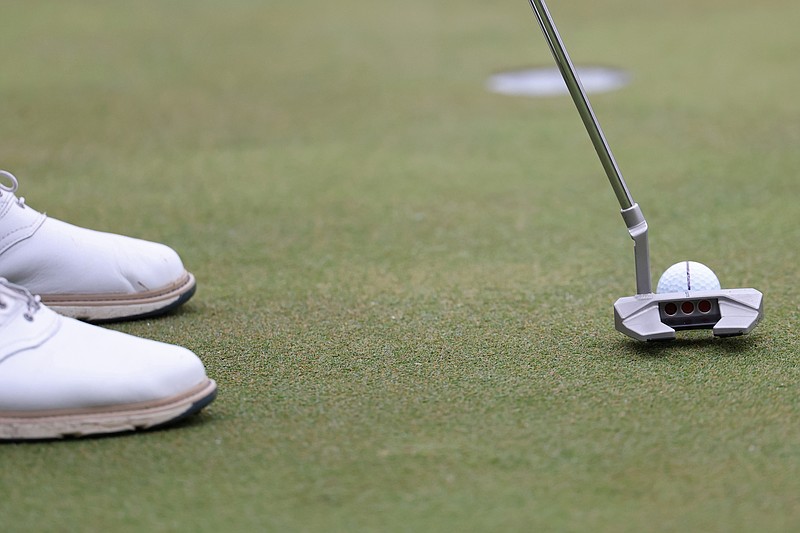
Jun 8, 2025; Gainesville, Virginia, USA; A view of the putter and ball of Martin Kaymer of team Cleeks Golf Club on the fourth green during the final round of the LIV Golf Virginia golf tournament at Robert Trent Jones Golf Club. Mandatory Credit: Geoff Burke-Imagn Images
I got a birdie for the first time this season.
When you’re a hacker like myself, getting a birdie is a rare and wonderful thing that comes only a few times a year. This wasn’t a dumb luck birdie either. You know, one where you chip in from 50 feet away or sink your third shot from the fairway because you topped your second shot.
No, this birdie was the real deal. A drive straight down the fairway, an approach landing 10 feet from the hole and a putt following railroad tracks straight to the bottom of the cup. It was a professional birdie.
This got me thinking, where did the word “birdie” come from? Not just that, where did most of these weird golf terms come from? There’s actually a word for the origin of words and that word is etymology.
You don’t need to know that, but this will be a learning column so put that little nugget in your head next time you’re hanging out with friends.
Back to the “birdie.” Take pride, my fellow Philadelphians, because the term birdie was started right around here (kinda).
A filthy rich guy named Abner Smith was crushing it at Atlantic City Country Club back in 1898 or 1899 when he nailed an approach to within a foot and exclaimed that his shot was “a bird of a shot” because “bird” was slang back then for excellent.
The term quickly became the turn-of-the-century meme and next thing you know all the filthy rich guys in America were calling one under par a “birdie."
It only makes sense that two under par be named after a bigger bird, thus "Eagle," also an Atlantic City Country Club creation.
In 19th century slang, a BIRD was anything or anyone particularly smart or impressive. It’s from there that BIRDIE came to be used to refer to a score of one under par in golf—and from there that many other golf scores, like EAGLE and ALBATROSS, came to be given birds’ names. pic.twitter.com/sNFsinaBJy
But wait, what if you get three under par for a hole?
Most of you probably know that’s an Albatross, which is a big arse bird. But there is one bigger one.
Yes, there is a term for when you go four under par on a hole.
Impossible, you say? Not really, as there have been six “Condors” in the recorded history of golf. Take that trivia to the water cooler.
For me an important golf term is, “Fore!” as I have yelled it many-a-time. This one goes back to Scotland when balls were expensive and the safety of peasants was secondary.
Golfers had caddies to hold their clubs and forecaddies to stand ahead of them to see where the balls landed and hopefully not get struck in the head. Golfers would shout “forecaddie” as a warning that their ball was headed their way. Today we shortened it to “Fore!” and instead of looking for balls, everyone just ducks and covers.
I mentioned a "forecaddie," so how about the term "caddie?" For this term we can thank the French. ... somewhat. Caddy derives from ‘le cadet’ the French term for young boy.
The Scots would use the term Caddie as an errand boy in the 17th Century and by 1857 the Oxford Dictionary made the golf term official for porters who carried clubs. By the way, back then they didn’t use bags, caddies had to walk around carrying a bunch of clubs in their arms.
Another term I am very familiar with is “Bogey.” There was a time when a bogey was considered the standard score in golf, not par. In the 1890’s there was a song about an elusive figure called, “The Bogey Man.” Back then even bogies were elusive which makes me feel a little better. Thus, to get the elusive standard score would be called a “bogey.”
But wait a minute, I thought “Par” was the standard score, not “bogey?”
Here’s where things get a little convoluted. The term “Par” comes from the stock market in the late 1800’s. Investors would describe a stock being either above or below the normal price, or par. It wasn’t until 1911 that the USGA officially defined par as the “score an expert player would be expected to make for a given hole.”
In a short time, “Par” became the accepted term for the expected score on a hole and bogey would become the score that recreational golfers would be happy with, and they were right. I’d take a bogey every hole if I could, but just once a condor would be nice.