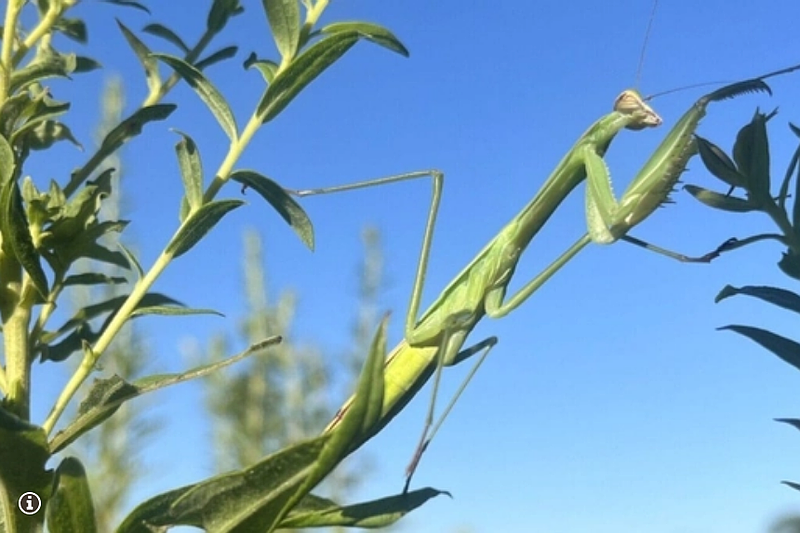
Praying mantis (Credit: Natural Lands)
The New Britain Township Environmental Advisory Council is asking residents to keep an eye out for non-native praying mantis egg sacs, warning that several imported species now common in the region can disrupt local ecosystems and harm beneficial insects.
While praying mantises are often promoted as “good bugs” that eat garden pests, township officials say larger imported species can be damaging because they prey on nearly anything they encounter, including pollinators and other native wildlife.
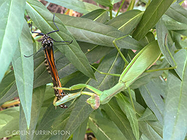 (Credit: Natural Lands)
According to the committee, invasive mantises are oversized compared with native species and will feed on everything from garden pests to beneficial insects such as bees and Monarch butterflies, and in rare cases have even been observed attacking small animals like hummingbirds. The township said native insects already play an important role in controlling garden pests and should be allowed to do so without competition from invasive predators.
The Carolina mantis (Stagmomantis carolina) is the only species native to the United States. It is considerably smaller, typically measuring about 2 to 2½ inches long, and is rarely found this far north. By contrast, imported mantises often reach about four inches in length, making them more dominant predators.
Natural Lands, a regional conservation organization based in Media, said the native Carolina mantis has been declining in many areas due to competition and predation from non-native mantis species. The most common invasive mantises in North America include the Chinese mantis (Tenodera sinensis), the European mantis (Mantis religiosa), and the narrow-winged mantis (Tenodera angustipennis).
The Chinese mantis was first introduced accidentally in Mt. Airy, PA, after arriving at a plant nursery, according to conservation groups. The insect is roughly twice the size of the native species and is considered an indiscriminate predator, feeding on pests but also beneficial insects, small reptiles and amphibians, other mantises and occasionally small birds.
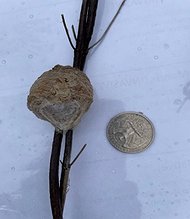 Chinese mantis egg sac (Credit: New Britain Township)
European mantises were introduced decades ago as a biological control measure to target gypsy moth caterpillars, while the narrow-winged mantis, another Asian species, was first recorded in Maryland in 1921.
Because mantises can vary in color from green to brown, identifying them in the wild can be difficult. Experts say their egg cases, known as oothecae, are often easier to distinguish.
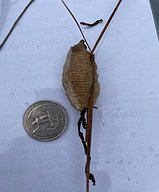 European mantis egg (Credit: New Britain Township)
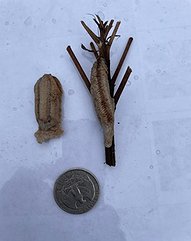 Narrow-winged mantis egg (Credit: New Britain Township)
Chinese mantis egg cases tend to be round and slightly smaller than a ping pong ball with a texture similar to Styrofoam, while Carolina mantis egg sacs are elongated and teardrop-shaped with a lighter central section. European mantis egg cases appear similar to the native species but are usually uniformly pale, and narrow-winged mantis oothecae often appear elongated and can develop reddish streaks as they age.
The township’s Environmental Advisory Committee encourages residents who find egg sacs belonging to non-native mantises to destroy them rather than relocate them. Recommended methods include placing the egg case in a freezer for a week or submerging it in water for several days.
Colin Purrington, a scientist and former evolutionary biology professor at Swarthmore College, suggested several additional methods of disposal, including crushing the egg cases, burning them, or feeding them to chickens or other animals that eat insects.
Purrington cautioned residents not to move the egg sacs to another location, which simply spreads the invasive species elsewhere.
Conservation groups such as Natural Lands have even organized “Mantis Meadow Walks,” volunteer events where participants learn to identify mantis egg cases and remove invasive species to protect native wildlife.
Residents who want to help with local environmental initiatives or learn more about invasive species can contact the New Britain Township Environmental Advisory Council at [email protected]. The council meets on the first Wednesday of each month at 7 p.m. at the township building, and the public is encouraged to attend.