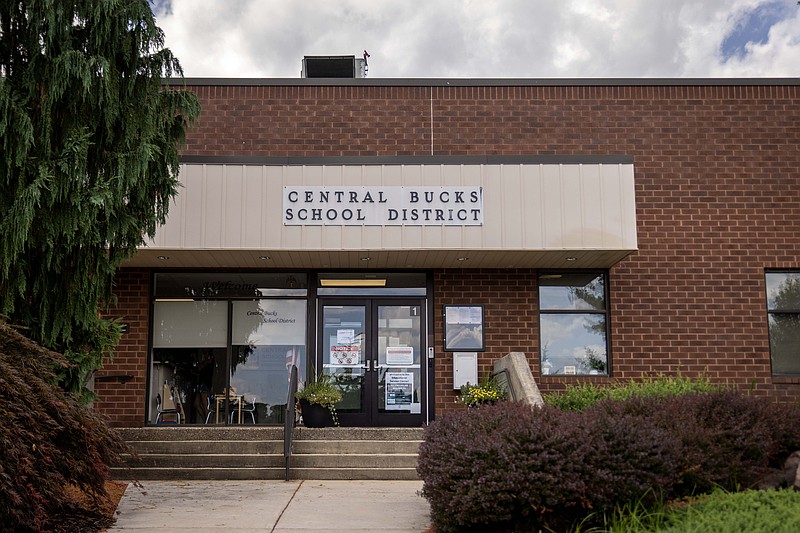
Central Bucks School District. Photo by James Short.
The Central Bucks School Board on Thursday unanimously approved an $454 million preliminary budget for the 2026-27 school year, formally launching the district’s annual budget process and opening the door to possible tax increase exceptions under state law.
The 8-0 vote authorizes the district to submit required financial data to the Pennsylvania Department of Education as part of the Act 1 process. District officials emphasized that the preliminary budget represents an early, high-level financial plan and does not lock in a final tax increase.
Interim Chief Financial Officer David Matyas said the state filing requires the district to list a higher potential millage increase than what was presented earlier this month, when administrators showed a budget built on a zero tax increase.
The higher figure — 7.99% — is used only to trigger a state calculation that determines how much the district could legally raise taxes if it qualifies for exceptions tied to rising special education costs.
“If we didn’t put in that higher millage rate, the state would only tell us we’re limited to the base Act 1 index of 3.5%,” Matyas told the board. “Submitting the higher number allows PDE to calculate what additional room we may have under the special education exception. It does not mean taxes will increase by that amount.”
Under Act 1, school districts are generally limited to an annual tax increase tied to an inflation-based index. Districts can exceed that limit only through voter referendum or by qualifying for specific exceptions, most commonly for special education and pension costs. Any increase above the state index is capped by a formula — and the board is not required to raise taxes to that level.
Matyas said the state’s calculation is based on the district’s actual special education spending from the past two years, not projected future expenses.
Board President Heather Reynolds noted the district followed the same process last year when seeking the special education exception. Board Member Rick Haring said he wanted clearer communication for the public, emphasizing that the higher percentage submitted to the state is a procedural step rather than a proposed tax hike.
The preliminary budget also reflects existing contract obligations and projected staffing needed to support grade realignment and the final phase of full-day kindergarten implementation in 2026-27, according to district officials. Administrators said the plan shows a deficit position that would be covered in part by using fund balance, while the district continues to review expenses and look for efficiencies in the coming months.
Matyas said the district expects to receive PDE’s response before the next finance committee meeting, at which point board members will review the maximum tax parameters allowed under state rules and continue refining the spending plan.
The final 2026-27 budget must be adopted before July 1, 2026, when the new fiscal year begins. The board plans to adopt the budget at its May 28 meeting.
The presentation earlier this month noted Pennsylvania faces long-term state budget deficits, which reduces the likelihood of meaningful new state education funding in coming years. That pressure shifts more burden to local taxpayers.
At present, the proposed preliminary budget has total projected revenue at $419.2 million, with $323.8 million, or 77% of the revenue share, coming from local sources, with state accounting for 22% of revenue for the school district, at $92.8 million.
Total projected expenditures of $454.3 million encompass $361.2 million in salaries and benefits, at 79% of the expense budget, $32 million for insurance and other services, and $17.3 million for debt service. Personnel costs remain the dominant driver of spending.
Most spending growth is tied to core classroom instruction and support operations, at $272.6 million for the former and $150.7 million for the latter, according to the preliminary budget.
Deficit trend
The district shows a growing gap between revenue and expenses, with a $2.4 million surplus appearing in 2023-24, and then an $8.8 million deficit the next fiscal year. The proposed deficit at $35.1 million is about $20 million more than the current fiscal year.
Property taxes and millage
Millage has risen steadily after several flat years:
Over 10 years, the district showed a $897 total increase for a home assessed at $40,000 (about $89.70 per year on average). CBSD remains mid-range compared to other Bucks County districts, not among the highest, according to the district.