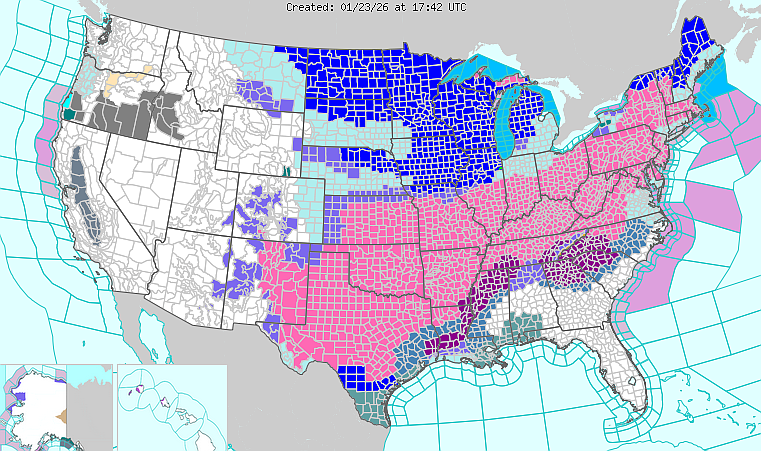
(Credit: NWS)
A Winter Storm Warning has been issued for Montgomery and Bucks counties as a powerful winter system is expected to bring heavy snow, ice, and dangerous cold from Saturday night through Monday afternoon, according to the National Weather Service.
Forecasters said the storm could produce 8 to 12 inches of snow in Montgomery County, along with ice accumulations near three-tenths of an inch, while Bucks County could see 10 to 15 inches of snow with lighter icing.
The warning is in effect from 7 p.m. Saturday through 1 p.m. Monday.
The National Weather Service warned that a combination of heavy snow, sleet, and freezing rain could make travel very difficult to nearly impossible, particularly during the Monday morning commute.
Significant ice buildup on power lines and tree limbs may lead to widespread and prolonged power outages, especially in areas closer to the Interstate 95 corridor, according to the NWS.
Meteorologists said confidence continues to increase that the storm will bring major impacts across southeastern Pennsylvania, as a low-pressure system moves northeast along the East Coast while bitterly cold air settles into the region from Canada, according to the NWS.
Snow is expected to begin Saturday evening, with a period of mixing or freezing rain possible Sunday before temperatures plunge again.
In addition to snowfall, the region is expected to experience dangerously cold temperatures and wind chills lasting well into next week. Wind chills in the single digits or below zero are possible overnight, increasing the risk of hypothermia and frostbite during prolonged exposure.
No flash freeze is expected with this event. Snow and ice covered surfaces will be slow to melt, with well below freezing temperatures through most of next week, the NWS said.
Officials urged residents to avoid unnecessary travel, prepare for possible power outages, and keep emergency supplies on hand. Drivers who must travel were advised to carry extra food, water, and a flashlight in their vehicles.
Road conditions can be checked by dialing 511, and residents were encouraged to monitor local forecasts and municipal alerts as conditions evolve.
How can there be sleet with 20-degree surface temperatures?
The NWS said precipitation falls through a warm layer of air temperatures, just above freezing, about 6,000 to 9,000 feet above ground. This is enough to melt snow, despite a surface air temperature of 23 degrees, the NWS said.
The melted snow then falls back through a deep layer of well below-freezing air temperatures, refreezing into sleet. According to the NWS, sleet has a much lower liquid ratio, about 3:1, and is much more dense compared to snow, at around 10 to 15:1, which is why sleet results in lower accumulation totals than pure snow.
Storm timeline and evolution
The NWS Friday morning briefing shows this is a long-duration, multi-phase winter storm, not a quick hitter.
Temperature and cold-air concerns
The NWS emphasized that the storm is followed by bitter cold, which compounds impacts:
We will continue to update the community on the storm throughout the weekend.