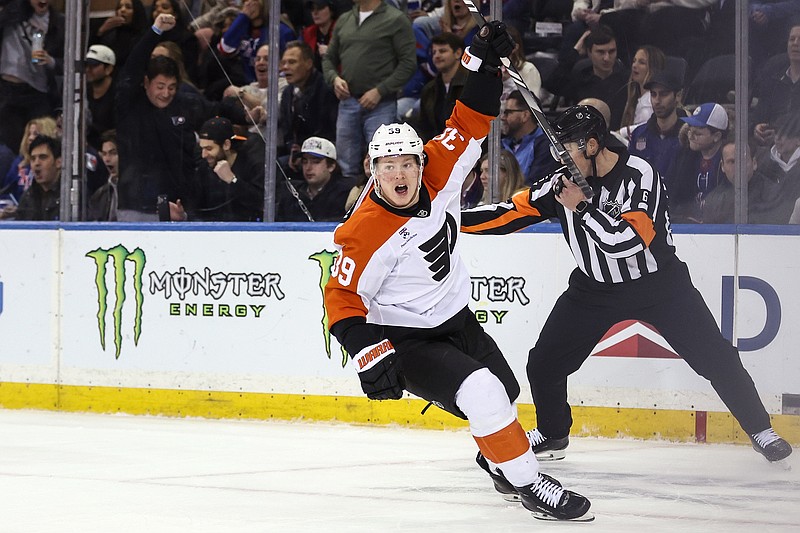
Feb 26, 2026; New York, New York, USA; Philadelphia Flyers right wing Matvei Michkov (39) celebrates after scoring a the game winning goal in overtime against the New York Rangers at Madison Square Garden. Mandatory Credit: Wendell Cruz-Imagn Images
In two games since returning from the Olympic break, every side in all the debates about Matvei Michkov had some evidence to support their arguments play out on the ice.
Whether it was the positives - like scoring a pair of goals in a gutsy, come-from-behind, 3-2 overtime win, like Thursday against the Rangers - or the negatives such as bad positioning, turning over the puck or taking an ill-timed penalty, which occurred across both games, both his blind supporters and his chronic detractors had something to hang a hat on and do so securely.
And while one day there will ultimately be winners and losers in these debates, the fact that they rage on tell you all you need to know about Michkov - that he's a talented enough player to be a difference-maker in the NHL, but just needs to be molded properly.
That's the funny thing about all the hand-wringing over him, because, aside from those who get their jollies simply from being an agitator, both sides want the same outcome - for Michkov to succeed at the highest level - the argument is not about that, but how best to get him there.
It's, in short, the horseshoe theory in sports - where both sides of the tips of the argument are actually closer to each other than to the neutral center of the curve of the horseshoe.
It all starts with Michkov moving his feet.
When he decides to skate, he is better able to showcase his talent. He has been a noticeable player both in Washington and in New York this week on the shifts where he is moving all over the ice.
He set up the lone goal in Washington. He scored twice against the Rangers and nearly had a third were it not for a great save by Rangers goalie Igor Shesterkin.
And each play were the results of him getting into a good spot on the ice.
MATVEI MICHKOV BLOWS BY J.T. MILLER AND WINS IT FOR THE FLYERS IN OT 🫨🚨 pic.twitter.com/bfMfpkwj6o
"(The OT goal) was a hell of a goal," Flyers coach Rick Tocchet told reporters after the game. "(Igor) Shesterkin is a hell of a ogalie and (Michkov) went five hole there. He sold it. That's the stuff that he can do. Even the (first goal) that [Noah Cates] passed to him. That's a nice little sweep shot. ... He had some confidence yesterday (too), so he's getting some confidence here."
If you watched the ESPN broadcast of the game on Thursday you heard analyst Ray Ferraro talk about the whole left wing vs. right wing debate being overblown.
And that's because it is.
On Cates' goal on Wednesday, Michkov was the left wing, but setup the play by making a pass from the right side of the ice.
Later in the same game, he had a chance to score, but was stopped by a nice save by Washington goalie Logan Thompson. On that play, he came off the left wing, skated hard to the open ice, and then his linemate and right wing Bobby Brink got to the puck on the left side of the offensive zone and fired a beauty of a pass across the front of the net to Michkov for a great chance.
His first goal Wednesday was on the power play, so he was on the right side anyway, because on his unit, that's the side he plays because they run the offense from the half wall on the right side (Trevor Zegras is the guy on the other power play unit in the same spot as Michkov).
But then on the game-winner, Michkov streaked down the left side of the ice, blew past gassed New York captain J.T. Miller and beat Shesterkin to the five-hole.
Granted, that was the result of Michkov coming out of the penalty box on that side of the ice and being there already, so it wasn't something structural but really opportunistic. He was in the right place at the right time. It showed that he had the skill set to score from wherever on the ice, regardless of it being left or right.
As a reminder, the whole left/right debate in the minds of coaches comes down more to the way a winger plays defensively both in their own end and the neutral zone, and less about where they are set up in the offensive zone, where there is more freedom within the system to create from wherever a forward can find time and space.
Matvei Michkov on the power play 🚨 pic.twitter.com/W5sA4NO3ng
"He had two big goals," teammate Travis Konecny told reporters after the game. "First, obviously, the overtime one, but I thought ... the first one was a timely one that helped us calm down and get us back into it.
"He's playing great. He looked fast."
Don't usually here those words, eh?
There was a lot of good in the two games from Michkov. He definitely looks to have a little more jump, indicating that he wasn't just being lazy in the Caribbean over the break, as some detractors would suggest.
But there are still mistakes in his game that are too frequent and he needs to clean up that don't come from overthinking because he's playing a new position, or have anything to do with his conditioning.
With the Flyers having a chance late Wednesday in Washington to tie the game, having a two-man advantage with the goalie pulled in the final minutes, Michkov was cheating into the offensive zone a little too far to the middle of the ice, so that when Konecny rimmed the puck around the boards on a zone entry to where Michkov should have been to take possession and allow the 6-man unit to set up, he wasn't there.
The puck drifted out of the zone, the Capitals got to it and scored an empty net goal to seal it.
That didn't cost the Flyers the game - a bad line change and an unfortunate deflection on Washington's go-ahead goa a couple minutes earlier was the more pivotal play - but this empty-netter was a dagger because the Flyers didn't even have a chance to set up shop with two extra skaters.
And it wasn't the result of being lazy, or out of shape, or because he was positionally a square peg being forced to play in a round hole on the opposite wing, but rather simply him being out of position,
Then there are turnovers along the wall and near the blue line that aren't from a lack of hockey I.Q., nor are they from an inability to make a play, but rather it's the old coaching adage that players who struggle sometimes try to do too much.
Tocchet doesn't use that trope. but when he says things like having to play as a team and not as individuals, that's basically his message. In short, smaller, simpler plays are better for team success than trying to create something heroically by yourself.
Again, it's not an issue of selfishness by Michkov, or Tocchet stunting his creativity, but rather knowing that there's a time and place for all kinds of plays in hockey and knowing when the right time is to go for them and when it's not, and to make a smarter, safer play instead,
An then there's the penalty that nearly cost them their comeback Thursday. It's not 100% Michkov's fault, per se. He's trying to make a play. He's going to the net, which is something his coaches are asking him to do. He kind of gets boxed in by Rangers defenseman Adam Fox, but at the same time, you have to do everything you can to avoid contact with the goalie, especially in the final minute of regulation in a tie game.
But it worked out. The Flyers did an amazing job killing the penalty - especially goalie Sam Ersson, who despite letting in one of the worst goals of the season in the first period, actually played quite well with 23 saves - and Michkov was able to take advantage of an exhausted Rangers power play group when he came out of the box.
Considering he doesn't often see the ice in overtime this season, much to the chagrin of his fans, this will certainly be exhibit A for the prosecution forever going forward, circumstances be damned.
However, Tocchet acknowledged after the game that there could be some consideration for Michkov to start to see more overtime opportunities - not just because he scored this goal, but rather because they had been such a poor overtime team, that the coaching staff had been talking over the break about devising some new ideas to try out after the break that could include Michkov.
"We were talking about that over the break," Tocchet said. "We've lost, what, 11 overtimes? ... So we've got to try some different things. I think Matvei is skating better, so that's going to help."
It's all part of the maturation process of a young and up-and-coming player. And everyone wants him to reach his ceiling.
Its just a matter of the best path to get him there that has everyone so triggered.
Something tells me, one day, we'll all look back at this sophomore season uproar and laugh about it.