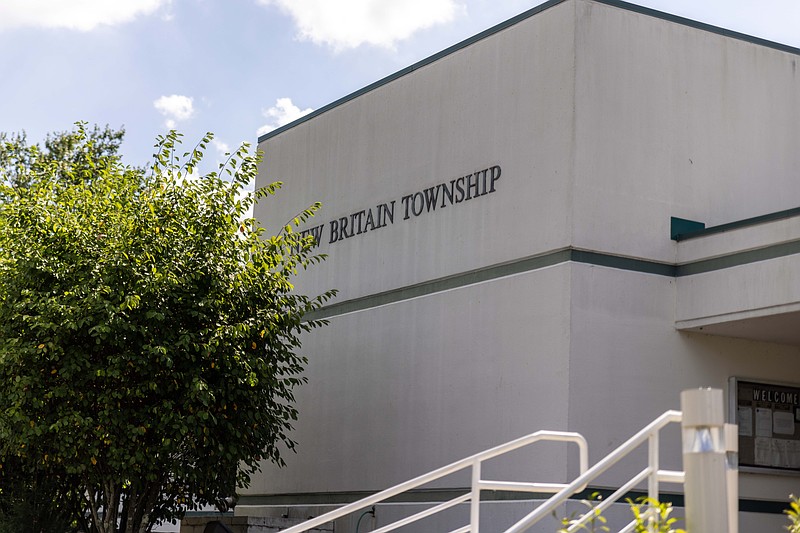
New Britain Township. Photo by James Short.
New Britain Township officials heard an update Monday night on a proposed multi-municipality watershed consortium intended to help towns tackle stormwater challenges, improve MS4 compliance support, and pursue grants for pollution reduction and flood mitigation projects across the Neshaminy Creek watershed.
Karen Ogden, speaking on behalf of the effort and noting her role with the Bucks County Conservation District, told supervisors the concept grew out of frequent coordination among watershed partners on tree-planting and restoration work, and a realization that informal collaboration was not enough.
“We were communicating weekly, bi-weekly about projects we were doing,” Ogden said, describing efforts that brought “hundreds or thousands of trees” into the county through grants.
“And it did not take long to realize that there has got to be a better way,” she said.
Ogden said the group approached New Britain and five other municipalities to form a steering committee spanning the headwaters to the mouth of the creek, with an initial focus on “pollution and flooding.”
Once the steering committee formed, she said, members quickly identified shared constraints: MS4 requirements, limited staffing, limited municipal budgets, and the difficulty of securing and executing large-scale stormwater projects.
“Projects are expensive. Grants are hard to get,” Ogden said. “The townships do not always have the money or the staff to actually execute a lot of these things.”
Four “most feasible and most valuable” services
Kenneth Jones, introduced as a project partner working closely with Ogden and the watershed association, said the steering committee reviewed stormwater collaboration models used elsewhere in southeastern Pennsylvania, then narrowed its focus to services that could realistically be launched and provide immediate benefit.
Jones said the group identified eight possible services, then used a feasibility-and-value analysis to select four “most valuable and most feasible” offerings. Those include:
Jones said the consortium would aim to reduce duplication by creating outreach materials once, then making them available to all member municipalities.
“If we create a podcast about storm water management, that is something that every municipality that is part of the consortium can leverage,” he said. “You do not all need to create this yourselves individually.”
“We handle the logistics, you guys get the credit”
A key component of the pitch, Jones said, was taking the administrative lift off municipal staff by tracking and documenting public participation that towns must report for MS4 compliance.
“We can actually capture the information of how the residents in New Britain Township are participating,” Jones said, describing how the portal would support MS4 reporting. “We handle the logistics, you guys get the credit.”
During supervisor discussion, a township representative emphasized that the “credit” referenced was not an added bonus but the documentation municipalities must provide annually to satisfy MS4 permit requirements, particularly for public education and involvement components that are often difficult to staff.
Proposed roles and membership cost
Jones said the proposed structure would assign the watershed association as the consortium’s fiscal agent responsible for financial administration, technology and content coordination, while the conservation district would serve as the technical authority providing regulatory guidance and best-management-practice expertise.
Ogden added that the conservation district expects to play an outsized role early in seeking “capacity building type grants” that, she said, may be more attainable with a formal consortium than through individual municipalities.
Municipal membership would cost $850 per year, Jones said, describing the cost as “fairly low risk” and “non-binding and voluntary,” with towns able to leave at any point.
Those funds would support creation of a website and portal infrastructure, along with education and outreach content, he said.
What New Britain is being asked to do next
Jones said organizers have provided draft documentation, including a draft memorandum of agreement that would require legal review. The group’s next hurdle is persuading six municipalities to move forward with the initial pilot structure, he said.
As part of membership, municipalities would appoint a representative, likely a staff member, to participate in steering committee meetings expected every other month during business hours. That representative would serve as a liaison between municipal leadership and the consortium’s work plan, Jones said.
A township representative who served on the steering committee, identified as Stephanie during the meeting, voiced support for the approach and said the process benefited from hearing the needs of multiple municipalities.
“I think the solution we came to makes the most sense for us to be able to leverage working with other communities,” she said, adding that cost was a major concern throughout discussions and the group refined the concept through multiple iterations.
Jones also noted that other municipalities have already asked to join, but the group wants to start small.
“Let us do a pilot. Let us see if we can make this thing work and then it can scale,” he said. “Do not make it too big to not be able to control it.”
Supervisors took the presentation under advisement. No public comment was offered during the question period at the meeting.