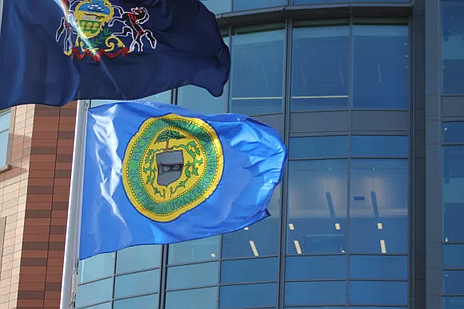
The Bucks County flag waving in the wind. File photo (Credit: Tom Sofield/LevittownNow.com)
Bucks County officials are working to deal with a $16.4 million projected deficit in the preliminary 2026 budget.
The Bucks County Commissioner – two Democrats and a Republican – could consider a property tax increase to balance the spending plan.
Bucks County Chief Financial Officer Jeannette Weaver went over the $516 million operating budget at a recent public hearing.
The proposed spending plan reflects a 3.2 percent increase in spending over 2025.
Including state and federal pass-through funds, grant programs, and remaining American Rescue Plan Act money, the county expects to oversee a total of $746.6 million in spending next year.
To cover the shortfall, officials are considering a 2-mill property tax increase.
Officials said the increase would generate approximately $16 million in new revenue and cost the average homeowner an additional $65 annually.
The current millage rate for the county stands at 27.45 mills and it has been unchanged since a 2-mill increase in 2024.
If the commissioners approve the additional 2-mill increase at their Wednesday meeting, the annual county tax bill for an average single-family home would rise from approximately $890 to roughly $955, according to officials.
“This is a deficit that we see time and time again,” Weaver said. “It becomes a structural deficit that if we do not increase revenues, a consistent stream of revenues to cover it, we will continue to see the deficit.”
Weaver said that salaries and fringe benefits, along with supplies and services, are major drivers of increased expenditures. They account for 39 percent and 57 percent of costs, respectively.
“We have a lot of unions here and we go through a rigorous negotiations process that results in some significant increases occasionally for the unions,” Weaver explained.
The county’s top budget official added that costs for “supplies and services due to tariffs, inflation, other items outside of our control, those costs we are noticing significant increases as well.”
The county receives the largest share of its funding, 46 percent, from the state, local taxes at 32 percent, federal funds at 8 percent, and the remainder from departmental, court, and row offices fees and services.
Health, housing, and human services make up the largest portion of county spending at 57 percent of the total budget.
Several row offices are planning to spend less in 2026, including the coroner with a 10.6 percent decrease, the district attorney’s office with 3 percent less, and the sheriff’s office at 1.5 percent less.
The commissioners’ own offices will also see an 11.8 percent decrease. General services and community services are also planning to spend less. Spending is also projected to rise for corrections, emergency services, the health department, and human services.
Several offices are budgeting for increases, including the law department with a 19.6 percent increase, voter registration and the elections office at 14.6 percent, and purchasing and the mail room at 20 percent.
The courts are projecting a 6.1 percent increase.
The county, which plans to start 2026 with a $76.8 million fund balance, also has a multimillion-dollar HVAC repair initiative at Neshaminy Manor, its nursing home facility, on the books. However, Weaver said the work is fully covered by the facility’s own funding sources and not tax revenue.
The county uses a zero-based budgeting process, which requires all departments to justify every dollar requested, beginning the process in July with final reviews in October.
The proposal drew concern from residents attending the budget hearing.
Chris Weber, of Hilltown Township, pointed out the millage rate has risen from 23.2 mills between 2012 and 2015 to the current 27.45 mills.
“I don’t know anybody that sees a 20 percent increase in their income in one year’s time,” Weber said. “We all have to find ways to balance our own budgets, and I think it’s only fair to ask the same of you.”
Another resident opposed the increase by reading a holiday-themed poem about taxes.
Commissioner Diane Ellis-Marseglia, the longest-serving member of the board and a Democrat, said officials will continue reviewing the spending plan before the final approval of the budget.
“We are going to continue to comb through the budget, take a look at expenditures that maybe we can reduce and other options that we have moving forward,” Weaver confirmed.